
Renters’ Rights Act Explained | Key Changes For UK Landlords, Tenants and Property Managers

Grace Russell
Mar, 28 2026The Renters’ Rights Act marks a landmark reform in England’s private rented sector, arguably the most significant change in over three decades, since the Housing Act 1988 reshaped private renting in England and Wales.
This legislation aims to create a fairer balance between landlords and tenants by improving security, raising standards, and enhancing transparency.
For property professionals, the Act introduces substantial operational and compliance changes. It reshapes the rental landscape, requiring landlords and agents to adopt proactive management practices, ensuring fair and compliant rent reviews, meeting new repair timelines, and maintaining thorough documentation.
While the reform raises accountability across the sector, it also presents an opportunity for professional landlords and managing agents to demonstrate excellence, trustworthiness, and real value in a more transparent market.
The Renters’ Rights Act – Key Reforms
- Abolition of ‘no-fault’ evictions (Section 21) and conversion of all tenancies into rolling periodic agreements.
- Rent increases limited to once per year and subject to tenant challenge.
- Ban on rent bidding (landlords cannot accept offers above the advertised rent).
- Extension of the Decent Homes Standard to private rentals.
- Tighter repair deadlines, with enforcement powers extended to local authorities.
- Cap on rent in advance (limited to one month).
- Mandatory landlord registration via the new Private Rented Sector database.
- Tenants gain new rights to request pets and greater transparency over terms.
The Renters’ Rights Act 2025 represents the most significant reform of England’s private rented sector in more than three decades, following the transformative Housing Act 1988. The new legislation seeks to rebalance relationships between landlords and tenants by strengthening security, raising standards, and improving transparency.
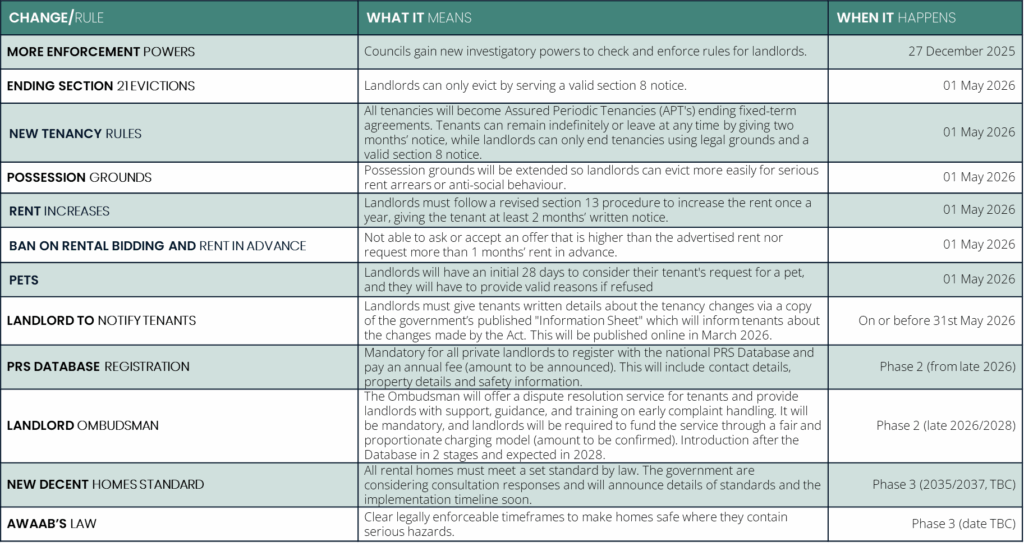
For property professionals, the Act brings major operational and compliance changes. It redefines the rental landscape, requiring more proactive management, tighter documentation, clearer and fairer rent reviews, and adherence to stricter repair timelines. The bill is due to come into force in three stages as outlined below.
While the reforms increase accountability, they also offer professional landlords and agents the chance to demonstrate high standards and real value in a more transparent market.
Three-phase introduction of the Renter ’s Right Bill 2025.
Phase One – 1st May 2026
1. All tenancies to become fully assured
- All tenancies will become periodic as of 1st May 2026. Fixed term tenancies will no longer be allowed. Tenants can end tenancy at any time with 2 months’ notice.
2. Abolishment of Section 21 (Overwriting from Housing Act 1988)
- Deadline for court proceedings for existing court proceedings 31st July 2026 or within 6 months of service (whichever is soonest)
3. Section 8 Possession Grounds Reform
- For existing tenancies, the notice does not have to be within the written tenancy agreement.
- For new tenancies commencing after 1st May 2026, grounds for repossession must be written into the tenancy.
When serving notice on either mandatory or discretionary grounds, evidence will be required.
Mandatory Examples
- Occupation by the landlord or closely related family (Ground 1 – 4 months’ notice) – This notice cannot be used within first 12 months of tenancy and the landlord cannot relet the property for 12 months after using this ground. Trusts cannot use these grounds for beneficiaries of a Trust.
- Sale of property (Ground 1A – 4 months’ notice) – The property cannot be relet for 12 months after using this ground.
- Occupation by agricultural work (Ground 5A – 2 months’ notice).
- End of employment by the landlord (Ground 5c – 2 months’ notice).
- Redevelopment (Ground 6 – 4 months’ notice) – required to demonstrate that works are not practical with a tenant in situ. Notice cannot be served in first 6 months of tenancy.
- Rent arrears for three months at notice and at possession hearing (Ground 8 – 4 weeks’ notice). If arrears are cleared prior to the hearing, the notice is redundant)
Discretionary Examples
- Suitable alternative accommodation (Ground 9 – 2 months’ notice)
- Any rent arrears (Ground 10 – 4 weeks’ notice)
- Persistent arrears (Ground 11 – 4 weeks’ notice)
- Breach of tenancy (Ground 12 – 2 weeks’ notice)
- Anti-social behaviour (Ground 14 – immediate effect)
4. Rental changes
- Any rent review clauses will become invalid.
- Rents will only be allowed to be revised once annually using a Section 13 notice,
- Tenants can challenge any rental increase at first tier tribunal.
- Landlords/managing agents cannot accept more than the advertised rent.
- Landlords/managing agents cannot accept any rent in advance – only once tenancy is signed, only one month’s rent in advance.
5. Enforcement regime
- Civil penalties are due to be expanded, and local councils must report on enforcement activity.
- The maximum fine for repeat offences will be £40,000 and for other offences £7,000.
- From 27th December 2025, local councils will have stronger investigatory powers including inspecting properties, demanding documents and access to third party data.
- Rent repayment orders will be extended to superior landlord.
6. Pets
- Tenants now have right to request a pet.
- The Landlord has 28 days to respond to a request and cannot unreasonably refuse.
- Landlords/managing agents cannot request a high deposit or the tenant to pay for insurance (Tenant Fees Act 2019).
View the information sheet released on the 20th March 2026 here.
Phase Two – Late 2026 (no date set yet)
1. Property database
- Landlords will be required to sign up to the Private Rented Sector Database and will require a fee to join.
- This will apply to all residential tenancies and licences to occupy.
2. Landlord ombudsman
- Will follow the introduction of the database and apply to 1988 Act Assured tenancies and Rent Act 1977 tenancies.
- The scope of work will be to take complaints from tenants and provide guidance to Landlords.
Phase Three – 2035 or 2037
Decent Home Standards
- Free from Category 1 hazards (HHSRS).
- Provides a minimum degree of thermal comfort (MESS).
- Awaab’s Law may be brought into private sector.
Support and Guidance for Landlords and Tenants
The Renters’ Rights Act has received Royal Assent, officially becoming law. While its main provisions are not yet in force, now is the perfect time to seek advice and prepare. Whether you’re a landlord or a tenant, contact us to understand your rights, responsibilities, and protections under the new legislation.
Contact the experts at Ceres Property today:
Grace Russell
grace.russell@ceresproperty.co.uk
07599 109933
Will Bell
will.bell@ceresproperty.co.uk
07592 039309
Read our original post explaining the Renter’s Rights Bill here
Relevant Service Areas