
Succession on Retirement Under the Agricultural Holdings Act 1986 (AHA)

Anna Loweth
Mar, 25 2026Introduction
Succession on retirement under the Agricultural Holdings Act 1986 (AHA) is a critical consideration for both landlords and tenants, particularly as farming businesses look to secure continuity for future generations. With recent reforms introduced in 2024, the rules governing succession have been modernised to reflect today’s farming realities, making it essential for all parties to understand the updated eligibility and suitability requirements. This guide provides practical insights into the process, key criteria, and what these changes mean in practice.
Guidance For Landlords and Tenants
Succession on retirement allows certain close family members of an Agricultural Holdings Act 1986 (AHA) tenant to apply for a new tenancy when the existing tenant retires. To succeed, an applicant must meet statutory eligibility and suitability tests. Reforms introduced in 2024 modernised these requirements.
This guide explains the process and includes brief examples to illustrate what applicants typically need to demonstrate.
Who Can Apply for Succession?
A successor may apply when a sole tenant retires or when all joint tenants retire together. Only two statutory successions are permitted.

Eligibility Criteria
1. Close Family Relationship
Eligible relatives include:
- Spouse or civil partner
- Child or treated-as-child
- Brother or sister
Example: A tenant’s daughter who has been working on the farm for several years may apply when her father retires.
2. Principal Source of Livelihood
The applicant must show that the holding was their main source of livelihood for at least 5 of the last 7 years.
Examples of evidence:
- Tax returns showing income from the farm
- Proof of receiving housing or other benefits tied to the holding
- Records of regular work carried out on the farm
Example: A son who has been paid through the farm partnership and lives in a tied cottage on the holding is likely to meet this test.
Suitability Criteria
The Tribunal must be satisfied that the applicant is capable of taking on the tenancy:
1. Farming Capability
Applicants should show they can farm the holding commercially and efficiently.
Examples:
- A 5-year business plan showing cropping, livestock, and environmental management
- Evidence of involvement in day-to-day farm operations
Example: An applicant who already manages the dairy herd and proposes investment in improved grazing infrastructure demonstrates capability.
2. Agricultural & Business Experience
Applicants must show practical experience and business competence.
Examples:
- Certificates in livestock husbandry or crop production
- Experience managing accounts, staff, or machinery
- Evidence of decision-making responsibility on the farm
Example: A sibling who has overseen the arable rotation and managed machinery purchases for several years is likely to satisfy this requirement.
3. Financial Standing
Applicants must show they can meet the financial obligations of the tenancy.
Examples:
- Recent accounts or tax returns
- Evidence of savings or access to finance
- Partnership agreements or shareholding documents
Example: An applicant who can demonstrate access to working capital and a viable cashflow forecast is more likely to be considered financially suitable.
4. Personal Character
The Tribunal may consider the applicant’s reliability, health, and general conduct.
Examples:
- Character references from professionals
- A doctor’s note confirming fitness to farm
- Evidence of responsible management roles
Example: A long-standing farm worker with strong references and a clean record of business dealings would typically meet this test.
Application Process
1. Timing
Applications must be made to the First-tier Tribunal within one month of the day after the tenant gives notice of retirement.
Example: If a tenant gives notice on 1 March, the successor must apply by 2 April.
2. Supporting Evidence
Applicants usually need to provide:
- Proof of relationship
- Livelihood evidence
- Business plan
- Financial records
- Training certificates
- References
Example: A complete application might include seven years of tax returns, a business plan, and letters from the farm accountant and agronomist.
3. Tribunal Decision
The Tribunal will assess:
- Eligibility
- Suitability
- Whether granting succession aligns with the purpose of the AHA
Example: If the applicant meets all tests and the farm remains viable under their proposed plan, the Tribunal may grant a new tenancy.
Key Changes – Effective 1st September 2024
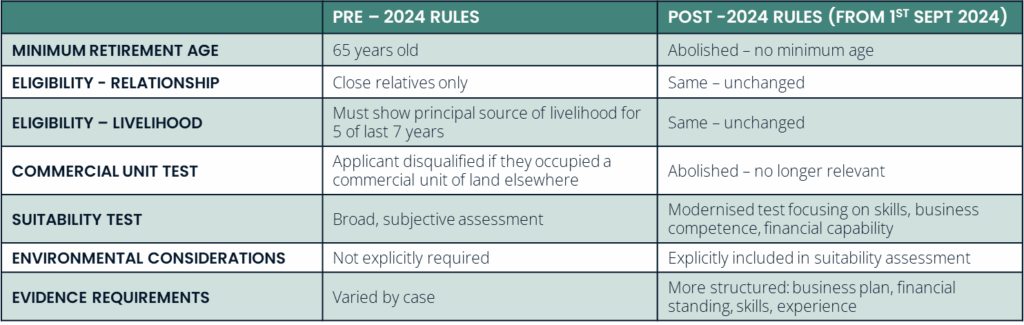
Effective from 1st September 2024, changes were made to AHA succession rules, as mandated by the Agriculture Act 2020.
Commercial Unit Test Abolished
Applicants are no longer disqualified for occupying other land.
New Suitability Test
The suitability test has been rewritten to reflect modern farming realities. Instead of a broad, subjective assessment, the Tribunal must now consider specific factors relating to the applicant’s skills, business competence, and financial capability.
Key elements now assessed:
- Agricultural skills and knowledge – practical experience, training, qualifications
- Business competence – ability to plan, budget, manage risk, and run a viable enterprise
- Financial capability – access to capital, financial resilience, ability to meet rent and repair obligations
- Environmental and stewardship awareness – understanding of modern environmental requirements and schemes
Why this matters: The new test is more transparent and better aligned with how farms operate today. It rewards applicants who can demonstrate a clear plan for running the holding sustainably and commercially.
Example: A daughter who has managed the farm accounts, completed BASIS training, and prepared a five-year business plan is likely to meet the new suitability threshold.
Streamlined Eligibility Test
Now based solely on relationship and livelihood.
What this means in practice:
- The focus is on whether the applicant has genuinely been involved in and dependent on the holding.
- Evidence such as tax returns, work records, and proof of housing tied to the farm becomes central.
- The rules are now more consistent and predictable for both landlords and tenants.
Example: A successor who previously farmed a second holding (which would have failed the old commercial unit test) may now qualify.
Comparison: Pre-2024 vs Post-2024 Rules
If you are a Tenant considering retiring or Landlord who has received notice from a Tenants and need advice, Ceres Property is here to help. Our experts can provide tailored guidance to support you through the process.
Contact Us
For professional advice on AHA succession planning, eligibility assessments, or Tribunal proceedings, please get in touch.
Anna Loweth
Partner
07599 110034
anna.loweth@ceresproperty.co.uk
Alternatively, visit our Contact Page to arrange a consultation.
Relevant Service Areas